

The Washington Post
Column by Dana Milbank
Why Harvard doctors are seeking out this natural remedy for themselves
As published in The Washington Post on October 31, 2025
Column by Dana Milbank
Original article can be found here: https://wapo.st/47Fp1IQ
BOSTON — Susan Abookire, an internist and professor at Harvard Medical School, had a cure for all that ailed me. But I was going to have a difficult time getting her prescription filled at CVS.
“Imagine that your body has roots,” she advised me, “and notice the roots. Watch them as they tunnel down from your body, through your legs and your torso down into the earth. Your roots are mingling with other roots in the earth. Imagine your roots have eyes and wonder what they might see.”
I was imagining my root-eyes struggling to see anything through all that dirt — but the doctor was not done with her instructions.
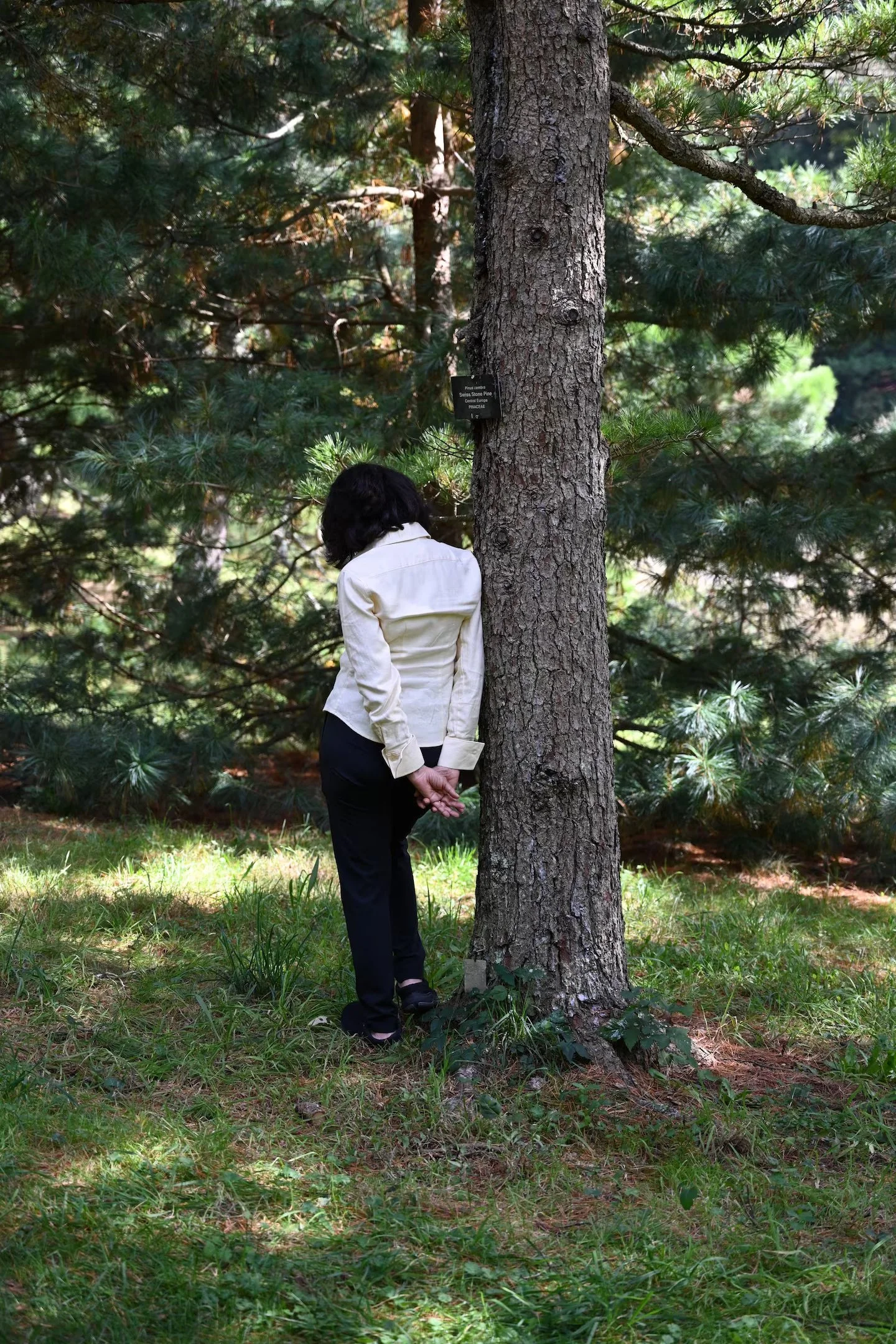
“Find a being. The being might be a tree or rock,” she told me. “Greet it as you would a friend. … You might want to introduce yourself. You may want to share something with that being.”
I was participating, somewhat skeptically, in a forest bathing session Abookire was leading at Harvard’s Arnold Arboretum for seven young doctors. It’s part of resident training at Harvard-affiliated Brigham and Women’s Hospital, which is looking for ways to reduce stress and burnout within the profession. Abookire also trains health care professionals nationwide to be “forest therapists,” a program accredited by Mass General Brigham that promotes nature as a form of medicine.
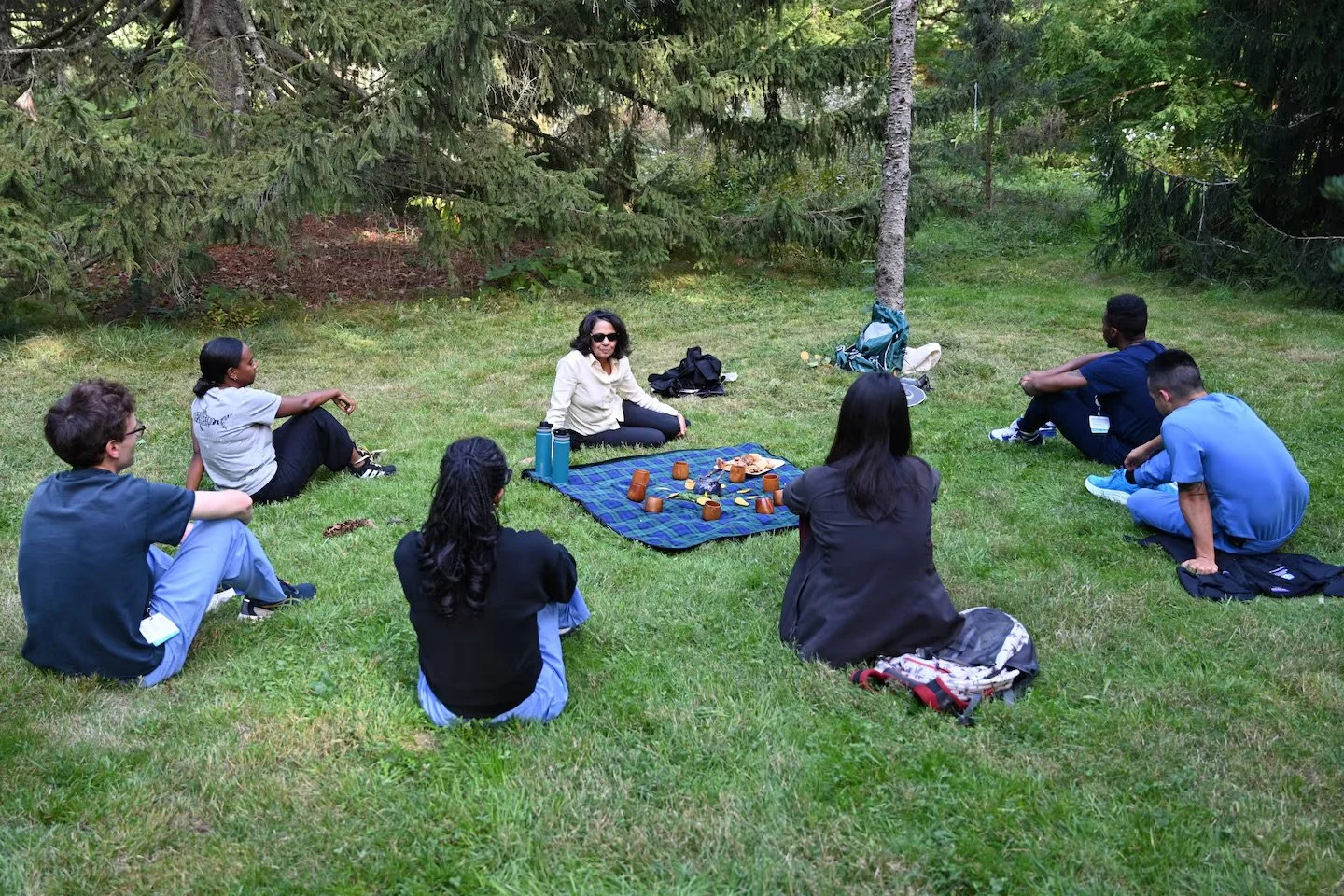
Abookire conducts a tea ceremony for medical residents. (Dana Milbank/The Washington Post)
Before I looked into forest bathing, I feared it might be another goofy wellness fad like Gwyneth Paltrow’s jade eggs and Tucker Carlson’s genital tanning. But here was a doctor from a top medical school, with the support of one of the top residency programs, guiding some of the brightest young medical minds into the woods.
So I did what the doctor ordered. I introduced myself to a mushroom.
“We’re standing here breathing in the atmosphere of the forest,” she told the residents, who had showed up in their scrubs, some carrying stethoscopes. She explained that just by standing among the trees, we were inhaling essential tree oils called phytoncides and aromatic plant compounds called terpenes. “There’s several studies now showing that inhaling phytoncides boosts our immune system, and specifically our natural killer-cell numbers and activities go up,” she said. “And there are a lot of studies going on — NIH, others, many in vitro and some in vivo — showing how terpenes are cytotoxic and anti-tumorigenic, they’re neuroprotective, et cetera.”
Breathing in tree scents fights infection, prevents cancer and protects against dementia? Deep underground, the eyes in my roots opened wide with delight.
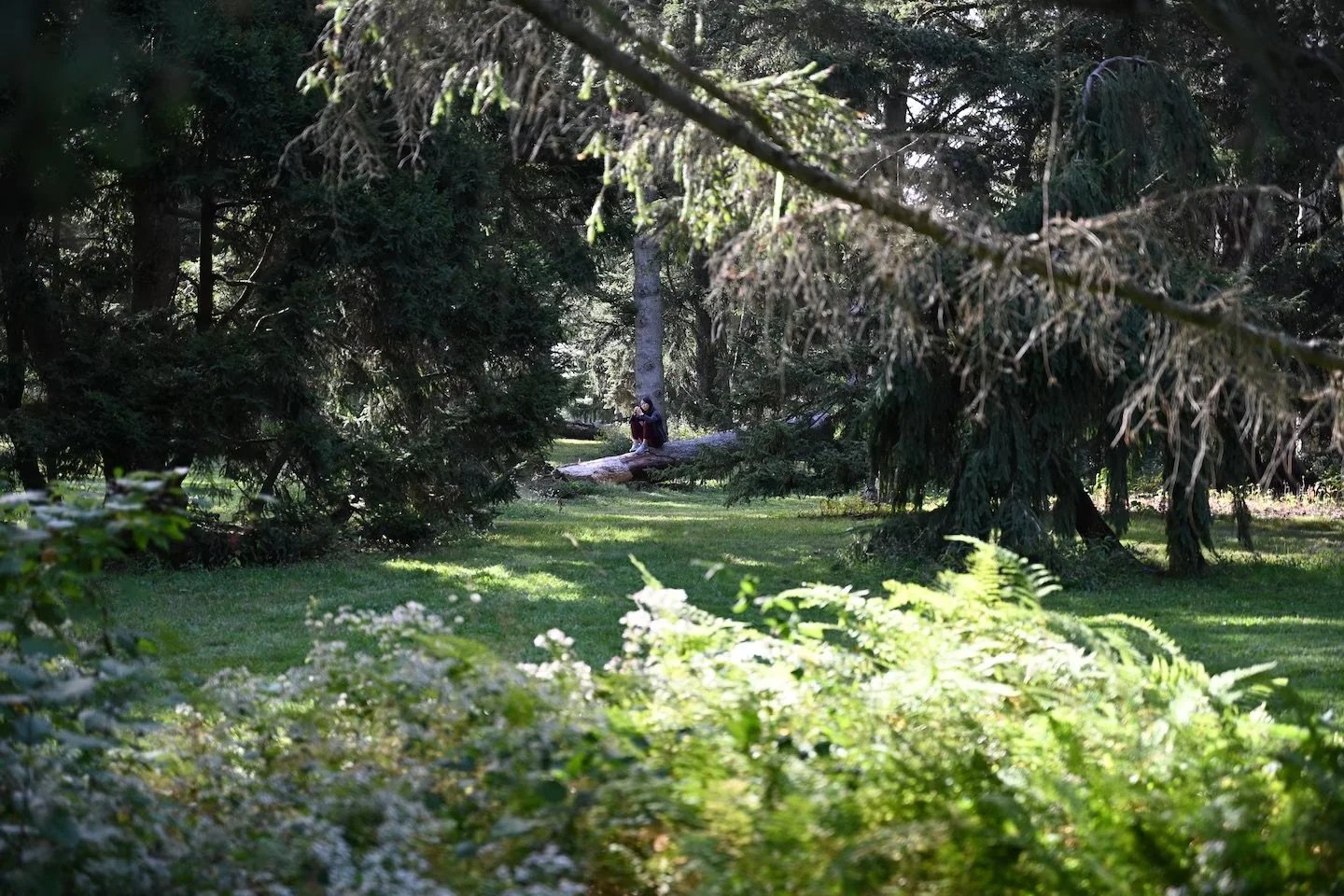
A medical resident reads a scroll during the forest bathing exercise. (Dana Milbank/The Washington Post)
People have gone to the woods for healing for thousands of years, but modern forest bathing originated in the 1980s in Japan, where it’s called shinrin-yoku. Now it’s becoming all the rage in the United States, too.
When readers first suggested I write a column on forest bathing, I had visions of getting poison ivy and ticks in unmentionable places — but I was reassured to learn that it is (usually) done clothed. Even so, it sounded … weird.
In his book “Your Guide to Forest Bathing,” M. Amos Clifford, founder of the Arizona-based Association of Nature and Forest Therapy, writes that humans don’t have just five senses but “at least 14,” including “body radar” and “imaginal communication.”
He recommends that people dedicate “rooms” in the forest and assign them names such as “Fairy Dance-a-Torium.” He reports that “you can ask water to carry messages” by scooping some up and whispering to it. He suggests flattering a tree with compliments and asking it for advice on relationships or other personal matters. But, he cautions: “Assume the whole forest is listening in like nosy but benevolent relatives.”
Clifford told me his 13-year-old organization, the first of its kind outside Asia, has certified more than 3,000 forest therapy guides.
Europe-based Forest Therapy Hub, also well regarded, has trained 2,500 worldwide. But the industry has no standardization, and Clifford complains about online “diploma mills” tarnishing the practice — a frustration for a serious man who tosses around Jungian phrases such as: “The outcome I’m looking for is the coemergence of self and opus.”
I can’t say whether your self and opus will ever coemerge, or even what that means. But I do know this: Forest bathing — or at least spending time in the forest — is good for you anyway.
In a 90-minute webinar for health care professionals called “Nature as Medicine,” Abookire cites study after study showing the benefits: lower blood pressure and anxiety; reduced stress-hormone levels; improved memory, attention, mood and sleep; faster recovery from surgery and illness; healthier gut microbiomes and more.
This makes sense. Voluminous research has documented the physical and mental health benefits of being in nature. Other research has measured the beneficial effects of meditation. So it’s only logical that an activity combining the two would also be good for you.
Less clear is that following a prescribed forest-bathing ritual is any better for you than, say, taking a walk in the forest and breathing deeply.
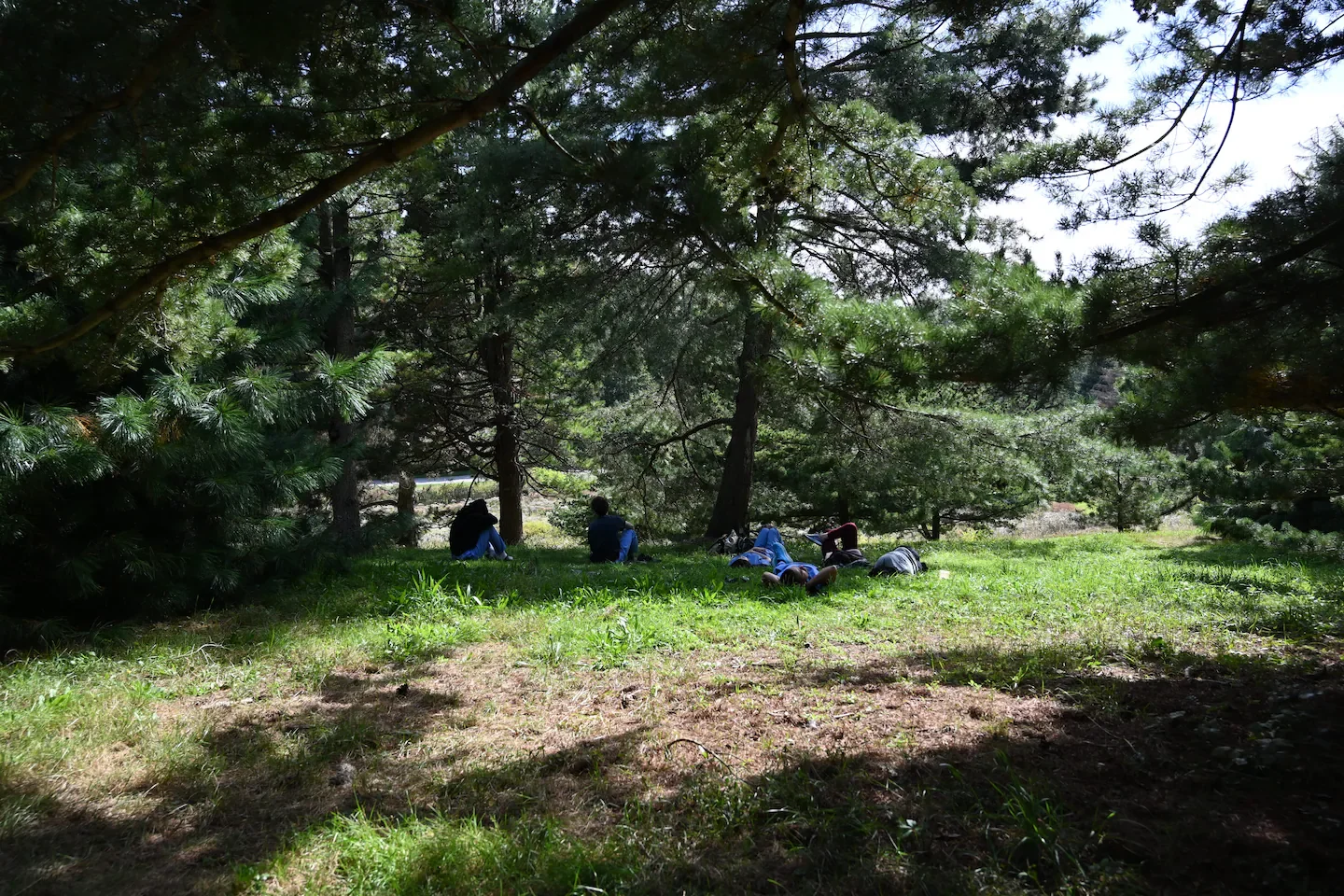
Medical residents “breathing in the atmosphere of the forest.” (Dana Milbank/The Washington Post)
Qing Li, a professor at Japan’s Nippon Medical School and a prolific researcher of forest bathing, believes the key is the phytoncides that trees emit, which he has found to boost immune function and anticancer proteins.
The many benefits of forest bathing — reduced depression and stress, better pulmonary and cardiovascular health — can be achieved even in city parks. But, he told me, “the larger the trees, the higher the tree density, and the larger the forest area, the greater the effects of forest bathing.” More phytoncides and more terpenes, more benefit.
He also believes we profit from inhaling negative ions (found in abundance near waterfalls) as well as a microorganism found in the soil, Mycobacterium vaccae.
Li’s method of forest bathing, and the Japanese method of shinrin-yoku generally, is far less structured than the style commonly practiced in the U.S. He recommends spending two to four hours in the forest walking at a slow pace (about ¾ of a mile per hour) and paying attention to your senses, while also taking time for yoga, tai chi, deep breathing or reading. He counsels removing shoes, dipping toes in water and standing barefoot for 20 minutes to feel “grounded.” The Japanese like to end the session by bathing in hot springs.
Li reports that the immune benefits of a two-night camping trip in the forest can last for a month. If you don’t have time for all that, you can also inhale phytoncides at home by using diffusers that disperse cedar and other essential oils.
Clifford’s version of forest bathing, a sequence of “invitations” proposed by the guide, is, by comparison, highly ritualized. That stems from his background in meditation. But even he allowed that an unstructured approach will suffice. “Just find a place you enjoy in nature and … go out there and enjoy yourself,” Clifford counseled. Sometimes he forest-bathes just by sitting in a folding chair by a lake. “It doesn’t need to be any more complicated than that.”
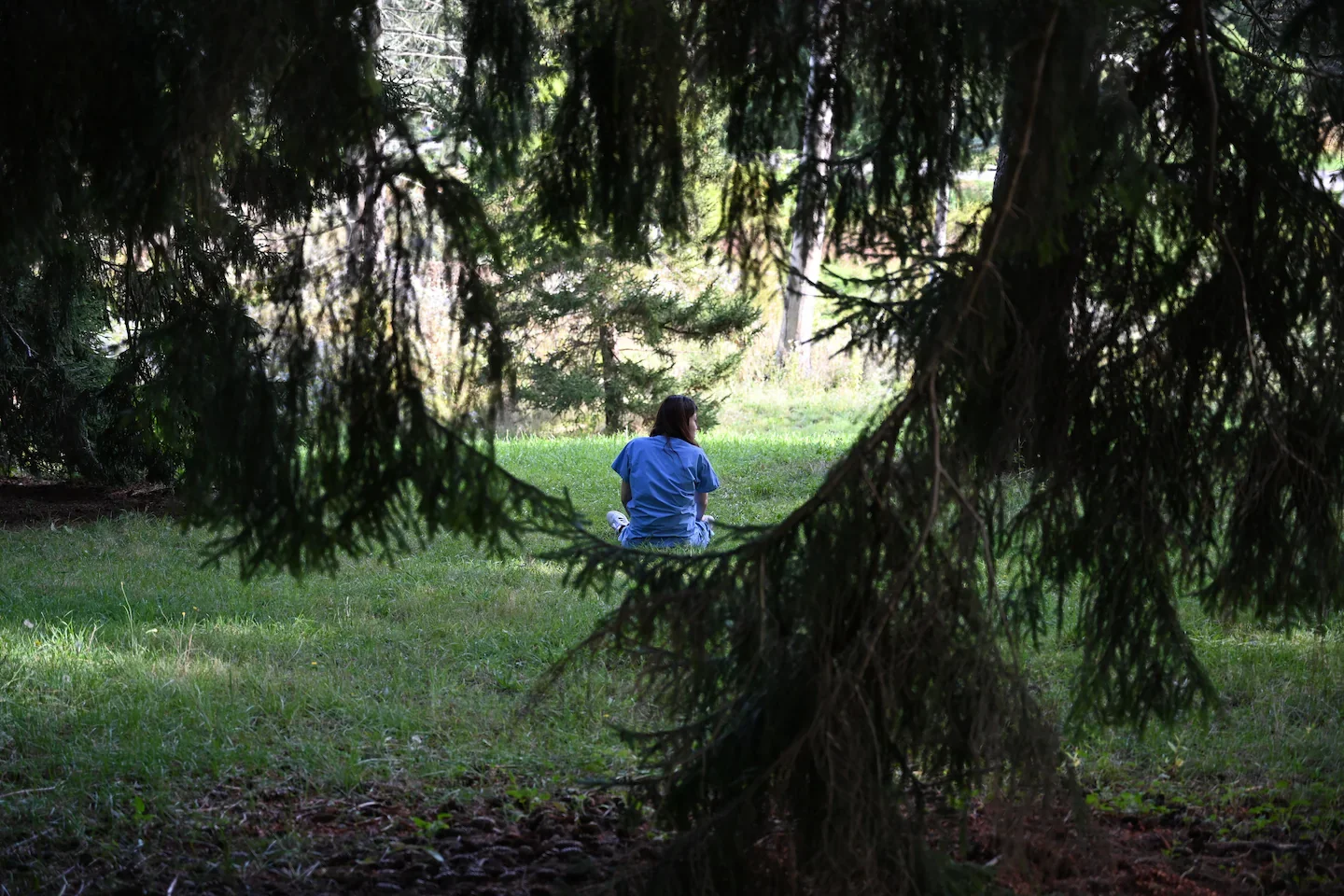
Medical residents “breathing in the atmosphere of the forest.” (Dana Milbank/The Washington Post)
It was a warm fall day when I followed Abookire into the arboretum. The asters were blooming, and the jays and squirrels were conducting their affairs in a grove of conifers. “I’m letting my heart lead me to where it feels magical today — and also practical,” Abookire explained. In this case, the practical considerations were significant: The ambulances approaching Faulkner Hospital across the street, and a landscaping crew in the park operating mowers and a wood-chipper, drove us deeper into the grounds.
She has been outdoorsy ever since she fell in love with the flowering cherry outside her home in suburban Cleveland growing up. “When I was a child, I had a deep relationship with a tree,” she confided.
She, too, was skeptical about forest bathing at first. “I thought, this is dumb. I don’t need anyone to show me how to be in nature,” she recalled. “But then you learn. It keeps getting deeper and deeper.”
She trained with Clifford’s group and now is trying to get a new generation of doctors to embrace the method.
“I’m here to slow them down and to give them an opportunity to just completely disconnect, which they probably haven’t done ever, to slow down and … to reconnect with that part of themselves that is human.”
This isn’t easy for the young doctors, who have spent their lives striving to get into the best colleges, then the best medical schools, and now one of the world’s best residencies. They seemed self-conscious as she had them repeat the birdcall she would use to call them back after each “invitation” to explore the forest. “Ow, ow, oww!” she called. “Ow, ow, oww,” they repeated, with rather less enthusiasm.
She had them sit or lie in the grass and asked them to describe what they were noticing.
“I’m noticing all the greenery.”
“I’m noticing that I feel a lot calmer than I was 10 minutes ago.”
One of them noticed an arachnid on Abookire’s sleeve. “There’s a spider on you,” she called out in alarm.
The professor told them to turn their phones off, to take their shoes off if they liked, to feel the air on their skin, to touch the earth, to take in the smells of the forest and “to let your tongue taste the air.”
“I’m seeing the tree looking back at me,” said one.
“This is the first time I’ve laid in grass in about 10 years,” marveled another.
“I’m noticing a lot of bugs on me,” said the one who raised the spider alarm.
Abookire invited them to wander around, noticing everything that was in motion.
“I’m noticing the grasses swaying in the breeze.”
“I’m noticing more and more bugs on my jacket.”
And I noticed the lawn tractors getting closer and louder. Abookire finally persuaded them to stop mowing for a few minutes.
We wandered some more, this time with instructions to bring back a “treasure” — a pinecone, a piece of bark, a maple seed pod — to describe and share. Next, we each selected a paper scroll from a basket and wandered among the trees some more to ponder the message it contained. Mine was attributed to the 13th-century Persian poet Rumi: “You are not a drop in the ocean. You are the entire ocean in a drop.”
After two hours of such quiet reflections, Abookire poured the residents sweet birch tea made from wood she had foraged and asked for their reflections on the afternoon.
“It’s a reminder to center yourself and ground yourself when things are chaotic in the outside world,” one offered.
“Usually when I’m outside, I’m either running or biking or doing something active,” another said. “I can’t remember the last time I was just being outside. So that was very nice.”
Before they returned to their pressure-filled jobs at the hospital, Abookire read them “When I am among the trees,” a Mary Oliver poem: “They give off such hints of gladness./ I would almost say that they save me, and daily.”
Must have been the phytoncides.